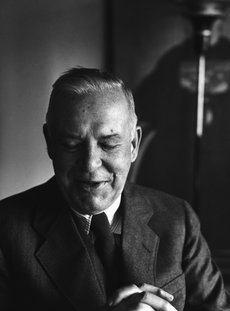
The phenomenon of Pennsylvania-born Wallace Stevens gives a guy like me hope. There was a day when great writers had post-university careers outside of the literary and academic fields. William Carlos Williams was a pediatrician, T.S. Eliot, a banker, and even more hopeful for me, Philip Larkin was a Librarian!
In this current literary climate where the expected track for a poet to take includes an MFA and a job teaching poetry somewhere, it’s encouraging for me to remember that some people managed to prove their worth, not with an impressive four line bio, and a list of degrees, but by doing the work, despite the fact that life didn’t make the prescribed career track feasible.
Stevens was expected to go to Harvard and be a lawyer like his father, and so he did, a lawyer, and insurance man, a company president eventually. But none of this changed the fact that he would eventually be considered one of the most important poets in American history.
Some of my favorite works of his include “Sunday Morning,” “Thirteen Ways of Looking at a Blackbird,” and “The Man with the Blue Guitar.” All of these poems have stretched my mind through the form they took as well as the ideas they conveyed. All of these poems seem to have in common a certain questioning commentary about the way we perceive our world, our reality and perhaps even the role of art within it.
Today’s poem has been called by one commentator, “the best short poem in the English language.” You can click on the link in the last sentence to hear his reasons why, as well as to enjoy Jay Keyser’s astute reading of the piece for NPR. And because I agree with John Nooney that much can be learned by listening to multiple readings of the same work, another good reading from the Poetry Foundation of Chicago can be enjoyed here. And for the rock star of poetry readings, listen to Tom O’Bedlam of YouTube renown. In the related articles below one blogger experiments with various ways of reading the poem himself. Personally, I don’t mind admitting that this excellent little piece had me for about twenty separate takes until I felt I had it right, and I’m still not sure.
There are several things about “The Snow Man” that intrigue me. It’s all one sentence, bending over five stanzas on hinges of “ands,” commas and one semi-colon. In fact, when I first read this years ago, I misread the phrase, “nothing himself,” set off by commas in the next to last line of the poem. I felt there was something important I was missing. Catching my error this time around has finally made the poem click for me in a way I hadn’t expected. Funny how we often try to impose our own will on a piece of art, rather than listening to what it’s actually saying, experiencing what it is doing.
That might be part of what Stevens is talking about, our perceptions of reality which are colored by our own imagination, not to mention the language we use to interpret and describe it. Some would argue that this poem advocates a complete de-personalization of the world around us in order to see things “exactly as they are (see his poem “The Man with the Blue Guitar”).”
But is he truly arguing for the need to “have a mind of winter,” or is he simply stating that we do not have that? We are not, after all, snowmen. Might he be saying that we only know the world through our interpretation of it? That we make up our own meaning as we go? These are perhaps questions that he and the Abstract Impressionists of his time want to trouble us with, but I don’t think we should be so quick to say that he was passing judgment on imagination.
After all, how could he write such a poem about “the nothing that is not there and the nothing that is” without imagination?
I should mention that this reading actually started as just my part of a collaboration with two other audio artists, and because of that you might soon see another version of this reading on The Dad Poet. And if not, it was at least a fun learning experience for me during a very cold and snowy winter here in my part of the world.
The Snow Man
by Wallace StevensOne must have a mind of winter
To regard the frost and the boughs
Of the pine-trees crusted with snow;And have been cold a long time
To behold the junipers shagged with ice,
The spruces rough in the distant glitterOf the January sun; and not to think
Of any misery in the sound of the wind,
In the sound of a few leaves,Which is the sound of the land
Full of the same wind
That is blowing in the same bare placeFor the listener, who listens in the snow,
And, nothing himself, beholds
Nothing that is not there and the nothing that is.
Related articles


Talk to me: