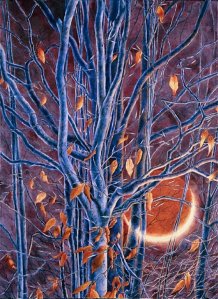
I’ve been meaning to work on this reading for a while now, and it seems appropriate that I happen to be uploading it on one of the many days in our silly history that people were expecting the world to end. Alas, not yet. At the rate we are going, I wonder if mankind will survive itself to see the sort of end of the world “as we know it” that this poem describes.
There are several things I like about this piece. It intrigues me that the opening line seems ambiguous when heard, as if it might be implying “its” awful stillness, as in an awful stillness possessed by the moon. But that’s not what the poem says. There is the apostrophe which makes it a contraction of “it is.” It is awful stillness the moon feels. And the difference was a challenge for me to find the best sounding way to read it aloud.
Stafford’s diction and syntax recalls something of Emily Dickinson’s style, the playful delight, dancing on the edge of ambiguity and implication. It gives one pause, makes one read again, and more slowly. Not everyone can pull this off, but Stafford like Dickinson before him, does it with grace, and makes me delight in the unique flavor of his language.
I’m also intrigued by the use of commas in this poem. They give the reader pause in line two and the slow down of speech seems to me to echo the moon’s largeness, its ponderousness. In the final line, without even an oxford comma, the “old eternal cities and monuments and mountains” are linked together solely by the article “and.” Without the commas, do they seem to rush along, do they seem less big, less eternal than the slow, ponderous moon in the previous lines?
The paintings are all by my amazing friend Michael McFarland. Nobody captures the magic of wilds and the skies of Pennsylvania and the Eastern U.S. like he does. See more of his work, and inquire about exhibits and purchasing at McFarlandArt.com.
The quiet, magical mood music in the background is the beautiful work of my husband-to-be, pianist, Mr. Brian Kelly.
Read along with the text below the video, and enjoy the world failing to end today.
Looking Up at Night
It’s awful stillness the moon feels, how the earth
wants it, that great, still, steady rock
floating serenely around. It knows it belongs
nearer its bright neighbor that shepherds it through
the sky. And the two begin to converge toward
the docking that will shatter history and bring new continents
hissing out of the sea, and erase with tide
the old eternal cities and monuments and mountains.
© 1987 by William Stafford, from An Oregon Message, Harper and Row


Leave a reply to River Ice and William Stafford | The Dad Poet Cancel reply