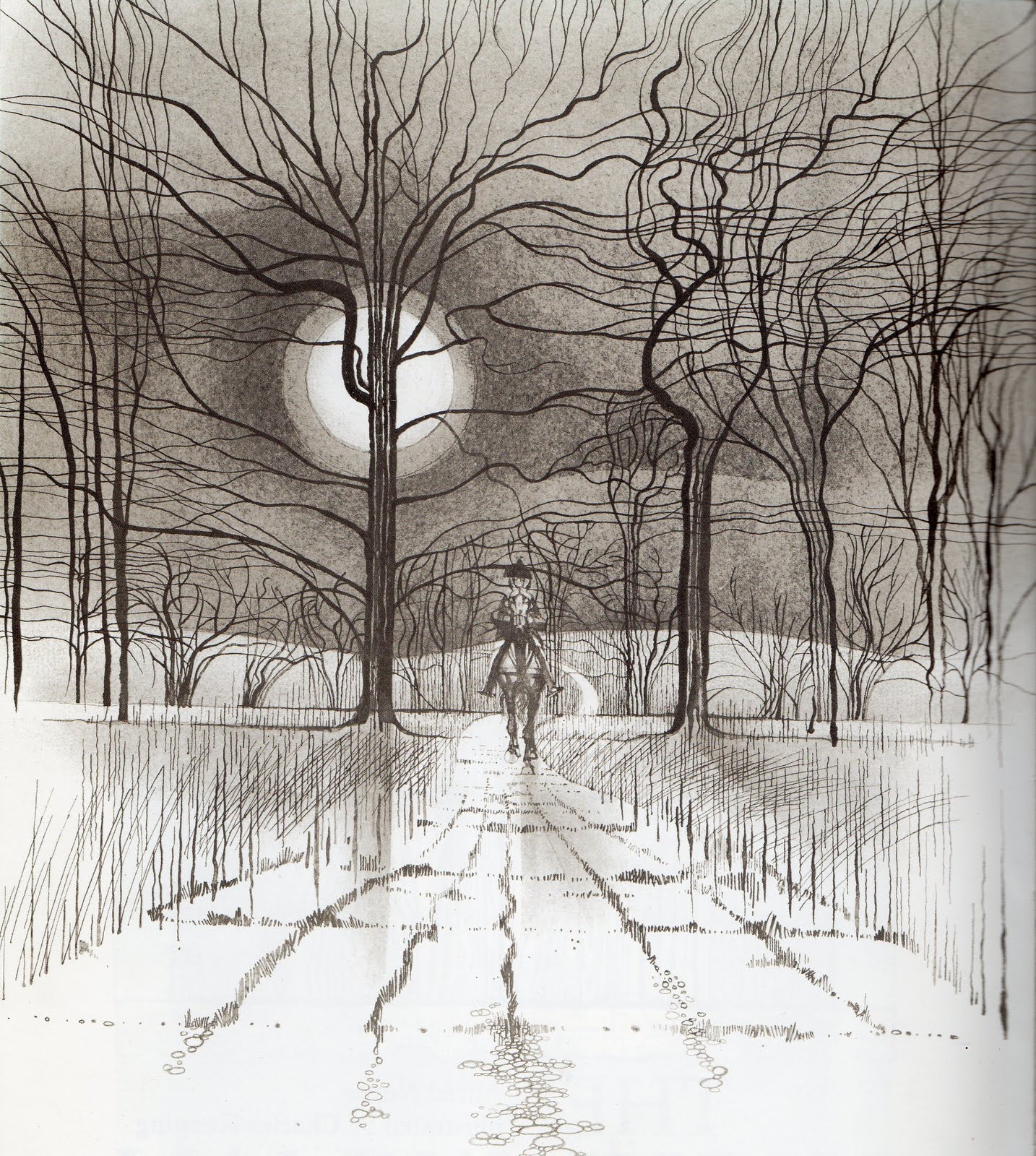
I had the immense pleasure Sunday morning of reading a second time at the Priestly Chapel here in the tiny town of Northumberland, Pennsylvania. But I will tell you about that experience in my next post. For now, I want to skip ahead to talk about the next Poetry Under the Paintings event at Faustina’s Gallery in Lewisburg this coming Thursday, the seventh, and to share with you a poem by Alfred Noyes that I cannot stop singing. Yes. You heard me, a poem I cannot stop singing.
It’s interesting living with a musician. A poet and a musician together in the same house, loving and appreciating each other’s work, each deferring to the other as the expert in his field, while trying to give appropriate feedback when asked. Brian will be writing a new song and just lost in his world there across the room on his keyboard, while I am here typing on my laptop. And as much as I love listening to him play, I know that I need to almost tune him out in order to get my own work done.
That’s when he’ll stop playing, turn to me and say, “What did you think of that? Did you like it?” Of course, I have to ask him to play it again, because all the while he was playing I was fussing over the right word for that feeling of helplessness and anger when your brother is trying to teach you to swim but is actually in the process of drowning you.
So I say, “Huh? I didn’t recognize the song.”
“That’s because I wrote it. I’ve never played it for anyone before.” Talk about missing an opportunity! So I ask him to please play it again. It’s truly lovely living with a musician.
When it comes to song lyrics, I start puffing out my chest as if we are in my territory of expertise. But I need to remind myself that Brian is damn good with words also, and that the song is in fact a song, not a poem. And so if “Baby, baby, baby, ooooh baby” actually does fit the emotion, the lift and drive of the music then I should just let it go and not impose judgment on the song’s lyrical lameness.
He already knows well that my poems do not have to rhyme in a traditional, rhythmical sense, and he just lets them be what they are. Having said that, he does have a great sense of rhythm, and an ear for the subtle things my poems do that even I don’t always notice at first. And so in critique he can give me valuable feedback on whether or not a certain line or phrase is living up to what the rest of the poem is trying to be.

Similarly it is a problem for me when I feel the lyrics of a song seem to stray from the intention of the music. If the intensity of the music does not match the weight of the lyric I feel put off.
For instance, I still contend that as marvelous and untouchable as Whitney Houston’s credentials are, the crescendos throughout most of her song “All at Once” feel out of touch with the lyrics. To hear her sing it I get this bizarre notion that what has really upset her most is not that her man left her, but that he did it suddenly, “Ah-all at once!” I would think that good writers would have picked up on that, but then again, maybe there were just out to showcase an amazing voice and to hell with the words? Maybe.
However, when it all comes off, when the key is right, when the lyrics match the tempo, it’s amazing and satisfying on every level, as when Houston sings Dolly Parton’s song, “I Will Always Love You.” Then again, there is probably more than one reader who disagrees with me on that.
Now, song lyrics are not the same as poetry, in that they are different appendages of the same organism, meaning that the music and the lyrics are two legs, and one will tend to limp along in the absence of the other. Poetry, on the other hand, even if consciously metered must stand up by its own power. A while back Jenny Hendrix from the New Yorker defended Billy Collins’ claim that, “Lyrics just don’t hold up without the music.” The article is two years old but still worth reading. “Ask a musician what he or she first hear in a song and the answer is never the words.” Hendrix goes on to say that, “even for those of us who are more literary-minded, seeing lyrics written on a page often diminishes whatever pleasure they gave when embedded in the context of a song.”
Conversely the music can often be just lovely in and of itself, so maybe the words are less important than the melody. And yet, if you know the song, you just cannot stop yourself from singing the words in your head while hearing the instrumental version in the elevator.
In any case when they are presented together, music and lyrics really should compliment each other. This is why you don’t hear happy songs generally sung in a minor key, unless the artist is going for irony, or unless you are Paige Miles from season nine of American Idol, and unable to sort out Charlie Chaplin‘s emotional intentions for his piece, “Smile.” It’s a subtle art, making the key, the pitch, the whole shebang (technical musical term there) fit the words.

Having said all of that, there are lyrics that, if read apart from the song without prior knowledge of a melody, truly could stand up on their own. And there are artists who bridge multiple art forms by blending poetry and music together. In fact many have made the argument that poetry first began as song. And though Ned Rorem seems to disagree with that theory, composers like him have made a living out of putting poetry to music.
And that brings us back to Love Poems You Wish You’d Written, and to “The Highwayman,” by Alfred Noyes. A local friend named Shelly has asked me via email to read this tragic love poem in her stead for the February, Valentine’s edition of Poetry Under the Paintings. And this happens to be a poem (minus a few words) that Loreena McKennitt has gorgeously set to music. It has a very Alfred, Lord Tennyson feel to it, which is probably, having heard McKennitt’s musical rendition of “Lady of Shallot,” why I first mistook the Alfred’s to be the same poet.
And it so happens, that my beloved musician Brian just adores Loreena McKennitt, and already knows this song very well. You can see the moon and the stars aligning here, right? So I might take a risk this Thursday night and actually sing for the first time in twenty years in front of people, other than Brian and my sons in the car. After all, I used to be a choir boy. I sang in ensembles and duets. I sang solo in performances and ceremonies of various kinds, including my own wedding. I even directed a small church choir for a while, not because I was the best suited for it, but because nobody else wanted the job, and I enjoyed it. But boy, that was a long time ago.
This weekend Brian asked me to launch into it with him on the keyboard, but I said I wasn’t sure if I was up to it. “The quickest way to learn is to do it,” he said, “It’ll be awful, but it will be fun.” And so we dove in, and I was surprised how well it went. I am definitely out of practice, and I need to watch my timing, but it was breathtakingly fun. So I might, if I am brave enough and we have enough time to practice, just sing instead of read “The Highwayman.”
It’s about honoring the poem and the song, not about me. PUP is an intimate and forgiving group, and besides the music might just be the crutch I need to get through the poem’s eleven stanzas! And when it comes right down to it, I can sing the words, but I’m just not sure that in this day and age I can say, “His pistol butts a-twinkle,” while keeping a straight face.
Loreena McKennitt leaves out one verse that I think is very important to the poem, the one about Tim the ostler (basically the stable man), yet it somehow is alluded to by the intensity of the musical interlude in its place, and the general idea is assumed; someone was a rat. And I think that wisely she leaves out Noyes’ final stanza which is a repeat from early on. There is more tension where McKennitt chooses to end the song, and it says all it needs to. I think Alfred might even approve. It goes to show that the best editing is done with a knife, rather than a pen.
Click here for the entire text of the original poem, and here for more illustrations from Charles Keeping. And now, enjoy Loreena performing her rendition of today’s Love Poem You Wish You Had Written, “The Highwayman.”
Related articles
- Love poems you wish you had written #1 – David Constantine (dadpoet.wordpress.com)
- Love Poems You Wish You Had Written #1 – Wendy Cope (dadpoet.wordpress.com)
- Valentine’s Challenge – 14 Words (anexerciseindiscipline.com)
- The Misunderstood Aural Art of . . . Poetry (NoiseMadeMeDoIt.com)
- Reading Music – A Playlist for Tuesday, January 18 (cheaperthanrubies.com)
- The Antidote: A Reading of ‘The Riddles Of Merlin’ by Alfred Noyes (theepochtimes.com)


 I get permission sometimes, but. . .


Leave a reply to Anonymous Cancel reply